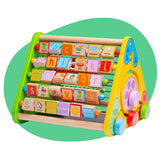
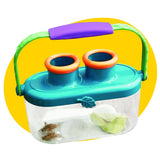
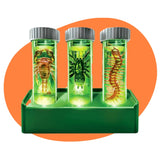
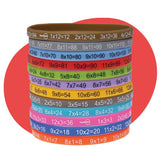
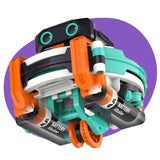

“STEM” is the label schools use for Science, Technology, Engineering and Maths as a group. A STEM toy takes one of those subjects and turns it into something a child can hold, build, test and get wrong, then try again. That last part matters: a good STEM toy gives a child a problem to solve rather than a picture to copy.
This page explains what counts as a STEM toy, the four main types, what suits each age, and how they differ from STEAM toys. It then answers the questions parents ask most often.
The four types of STEM toy, with examples
| Type | Example | What the child does | Age |
|---|---|---|---|
| Science | GeoSafari Jr. My First Microscope | Looks closely, compares, asks why | 3+ |
| Science | Buki Chemistry Set 150 Experiments | Mixes, measures and records reactions | 8+ |
| Technology | Thames & Kosmos Easy Electric Circuits | Builds working circuits, finds the fault | 8+ |
| Technology | Thames & Kosmos My First Coding and Robotics | Programs a robot with coding cards | 4–8 |
| Engineering | SmartMax Start Magnetic Discovery | Builds, balances, sees what holds | 1+ |
| Engineering | Thames & Kosmos Simple Machines | Builds levers, pulleys and gears that work | 8+ |
| Maths | Underground Brain Train | Plans routes, spots patterns, reasons logically | 5–11 |
What makes a toy a STEM toy?
Plenty of toys are labelled “educational”. A STEM toy is narrower than that. It usually has most of these:
- A real idea at its centre — a circuit, a force, a chemical reaction, a number pattern — not just facts printed on the box.
- Hands-on cause and effect — the child does something and sees the result straight away.
- A problem to solve — something that can go wrong, so the child has to work out why and fix it.
- Room to try again — it can be rebuilt, rewired or re-run with a different idea.
- Something that grows with the child — easy wins first, harder challenges later.
The four types of STEM toy
Science toys
Microscopes, magnifiers, crystal growing, slime and chemistry sets, weather and nature kits. They teach a child to look closely, predict what will happen and check whether they were right. Examples: science toys and chemistry sets.
Technology toys
Circuit kits, electronics, coding robots and gadgets the child builds rather than just switches on. The aim is for children to understand how technology works and make it themselves, not only use it. Examples: tech toys, electronic kits and robots.
Engineering toys
Construction sets, marble runs, simple machines, bridges and moving models. Engineering play is about making something that works — it stands up, it rolls straight, it lifts the weight — and changing the design when it does not. Examples: engineering toys.
Maths toys
Counting and number sets, logic puzzles, pattern and shape games, and strategy games where a child has to plan several moves ahead. Good maths toys make numbers something to play with rather than something to get right. Examples: maths toys.
STEM toys by age
- 1–3 years — magnetic and chunky building sets, stacking, simple cause and effect.
- 3–5 years — magnifiers and first microscopes, sorting and counting, first building challenges.
- 5–8 years — picture-instruction robots, screen-free coding, simple experiments with an adult nearby.
- 8–11 years — circuit kits, chemistry sets, simple machines and engineering builds they can follow alone.
- 11 and over — chemistry labs, renewable energy and robotics kits, more open-ended projects.
STEM or STEAM?
STEAM adds Arts to the four STEM subjects. Engineering rarely works without some creativity, so most toys sit across both — a robot you wire and then decorate, a structure that has to look good as well as stand up. There is more on this in What are STEAM toys?
Other names for STEM toys
People look for the same thing under several names: STEM kits, STEM gifts, science toys, educational STEM toys, STEAM toys and, most often, by age — “STEM toys for 7 year olds”, “STEM toys for 10 year olds”. They all describe the toys on this page.
Why STEM toys matter
The main benefits are problem-solving, persistence and confidence with maths and science. What STEM toys genuinely do for children — and what they cannot do — is covered in Why are STEM toys important? More examples by age and subject are in STEM educational toys for kids.
More questions parents ask, from sustainable toys to gifts by age, are answered in the BrightMinds Toy & Gift Guide.
Frequently asked questions
What is a STEM toy?
A STEM toy is a toy built so that a child learns science, technology, engineering or maths by playing with it. Building a working circuit, growing crystals, programming a robot to follow a path or working out why a marble run keeps stalling are all STEM play. The test is that the play itself is the learning, rather than a quiz added on top of an ordinary toy.
What does STEM stand for?
STEM stands for Science, Technology, Engineering and Maths. It is the term schools and governments use for those four subjects as a group, and a STEM toy is one that lets a child practise any of them through hands-on play.
What is the difference between STEM and STEAM toys?
STEAM adds an A for Arts. A STEAM toy brings design or creativity into the same hands-on learning, for example decorating a robot you have wired yourself or designing a structure that has to look good as well as stand up. Most STEM toys sold today have some creative element, so in practice the two terms overlap heavily.
What age are STEM toys for?
There are STEM toys from about one year old upwards. Toddlers start with magnetic building and simple cause and effect, three to five year olds move on to magnifiers, sorting and first experiments, five to eight year olds can follow picture instructions for robots and circuits, and from about eight children can manage proper science kits, electronics and mechanical engineering sets. Teenagers go on to chemistry labs and programmable kits.
What is a STEM kit?
A STEM kit is a boxed set of parts and instructions for a specific project or set of experiments, such as a circuit kit, a chemistry set or a build-your-own machine. It is the most common type of STEM toy for children aged about six and over, because it gives a clear goal and a finished result.
Are building toys like construction sets STEM toys?
Many are. Construction toys teach engineering ideas such as stability, balance, gears and load, especially sets that move or have to carry weight. A set becomes properly STEM when the child is solving a problem, for example making a bridge that holds or a car that rolls straight, rather than only copying a picture.
Are STEM toys only for children who already like science?
No. The best STEM toys hook a child through something they already enjoy, such as animals, space, music, vehicles or making things, and the science comes along with it. A child who says they do not like maths will still happily build a marble run and work out why it keeps jamming.
BrightMinds | BrightMinds Ltd, Unit 2 Barrys Lane, Scarborough YO12 4HA | Registered in England No. 3619051 | brightminds.co.uk